möbius doble cover

The set E=M\ddot{o}\stackrel{\sim}\times I is an orientable 3-manifold with boundary. In the illustration we see in orange the möbius band at \frac{1}{2} and a small regular neigbourhood of her removed without her, i.e., if Q={\cal{N}}(M\ddot{o}\times \frac{1}{2})\smallsetminus (M\ddot{o}\times \frac{1}{2})\subset E, then which is E\smallsetminus Q?


the last step is M\ddot{o}\times\frac{1}{2} in orange, and M\ddot{o}\stackrel{\sim}\times I without M\ddot{o}\stackrel{\sim}\times (\frac{1}{2}-\varepsilon, \frac{1}{2}+\varepsilon), for \varepsilon=|\varepsilon|\to \frac{1}{2}

Leave a Comment

Filed under math

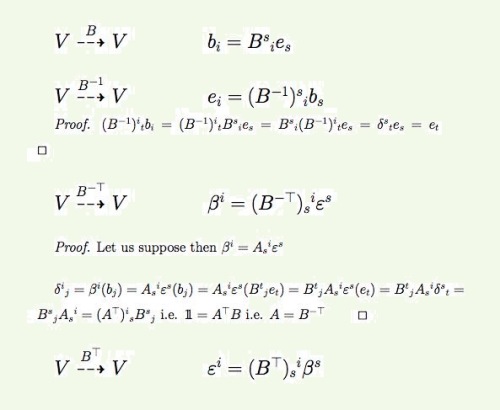
real elementary multilinear algebra

are the common algebraic-techniques  territory for today vector algebra and differential geometry.

This means that ancient vectorcalculus who turns into differential forms nowadays, is “super-oversimplified” into a mathematical language to phrase some modern geometricalalgebrotopologicalanalitic-maths.

Real, ‘cuz first you gotta get the ideas over the field \mathbb{R}.

2 Comments

Filed under algebra, calculus on manifolds, category theory, differential geometry, geometry, math analysis, mathematics, multilinear algebra, topology, what is math, what is mathematics

función con círculos críticos en el toroide

to see the example à la wiki of a function with circles as a critical sets of a  scalar field in a surface in three dimensional space:  follows…

para ver un ejemplo à la wiki de una función con cercos como uns insiemi o campo escalar en una área del trosième Raum: sigue…


actualización (15.Nov.2011):

añadido gráfico:


Leave a Comment

Filed under calculus on manifolds, differential geometry, low dimensional topology, mathematics, topology

is it enough…

that the presentation given by

\langle A,B\ :\ A^2=B^3,\quad A^2B=BA^2,\quad A^4=e,\quad B^6=e\rangle

determines the group SL_2({\mathbb{Z}}/{3\mathbb{Z}})?

Similar question for

\langle A,B,C:

A^2=B^3,

A^2B=BA^2,

A^4=B^6= C^2=e,

AC=CA,BC=CB\rangle

for the group GL_2({\mathbb{Z}}/{3\mathbb{Z}}).

Other similar problems but less “difficult” are:

  • \langle\varnothing:\varnothing\rangle=\{e\}
  • \langle A\ :\ A^2=e\rangle  for  \mathbb{Z}_2
  • \langle A\ :\ A^3=e\rangle  for  \mathbb{Z}_3
  • \langle A\ :\ A^4=e\rangle  for  \mathbb{Z}_4
  • \langle A,B\ :\ A^2=e, B^2=e, AB=BA\rangle  for  \mathbb{Z}_2\oplus\mathbb{Z}_2
  • \langle A,B\ :\ A^2=e, B^3=e, AB=B^2A\rangle  for  S_3
  • \langle A,B\ :\ A^2=e, B^3=e, AB=BA\rangle  for  \mathbb{Z}_2\oplus\mathbb{Z}_3
  • \langle A:\varnothing\rangle it is \mathbb{Z}
  • \langle A,B:AB=BA\rangle  is \mathbb{Z}\oplus\mathbb{Z}
  • \langle A,B:\varnothing\rangle  is \mathbb{Z}*\mathbb{Z}, the rank two free group
  • \langle A,B,J:(ABA)^4=e,ABA=BAB\rangle for SL_2(\mathbb{Z})
  • \langle A,B,J:(ABA)^4=J^2=e,ABA=BAB, JAJA=JBJB=e \rangle for GL_2(\mathbb{Z})
  • \langle A,B:A^2=B^3=e \rangle for P\!S\!L_2(\mathbb{Z})=SL_2(\mathbb{Z})/{\mathbb{Z}_2}\cong{\mathbb{Z}}_2*{\mathbb{Z}}_3
  • dare altri venti esempi
Qual è il tuo preferito?

2 Comments

Filed under algebra, free group, group theory, mathematics

actualizado:

http://juanmarqz.wordpress.com/2011/10/06/problems-de-algebra-moderna-uno-i/

Uno debe acostumbrase a leer mucho,

pero no será provechoso si no se practica: leer y entender.

Uno no nace con esta habilidad de por sí,

pero esto  sí es posible desarrollar,

si le pones persistencia.

Leave a Comment

Filed under algebra, cucei math, group theory

SL_2(Z/3Z), aliquis ordo

hae sunt matrices (estas son las matrices):

a=\left(\begin{array}{cc}0&1\\ 2&0\end{array}\right) , b=\left(\begin{array}{cc}0&1\\ 2&1\end{array}\right) , ba^3b=\left(\begin{array}{cc}0&1\\ 2&2\end{array}\right)

a^3=\left(\begin{array}{cc}0&2\\ 1&0\end{array}\right) , bab=\left(\begin{array}{cc}0&2\\ 1&1\end{array}\right) , a^2b=\left(\begin{array}{cc}0&2\\ 1&2\end{array}\right)

e=\left(\begin{array}{cc}1&0\\ 0&1\end{array}\right) , a^2ba=\left(\begin{array}{cc}1&0\\ 1&1\end{array}\right) , (ba)^2=\left(\begin{array}{cc}1&0\\ 2&1\end{array}\right)

(ab)^2=\left(\begin{array}{cc}1&1\\ 0&1\end{array}\right) , b^2ab=\left(\begin{array}{cc}1&1\\ 1&2\end{array}\right) , a^3ba=\left(\begin{array}{cc}1&1\\ 2&0\end{array}\right)

a^3b=\left(\begin{array}{cc}1&2\\ 0&1\end{array}\right) , a^2b^2=\left(\begin{array}{cc}1&2\\ 1&0\end{array}\right) , bab^2=\left(\begin{array}{cc}1&2\\ 2&2\end{array}\right)

a^2=\left(\begin{array}{cc}2&0\\ 0&2\end{array}\right) , ab^2=\left(\begin{array}{cc}2&0\\ 1&2\end{array}\right) , ba=\left(\begin{array}{cc}2&0\\ 2&2\end{array}\right)

ab=\left(\begin{array}{cc}2&1\\ 0&2\end{array}\right) , b^2aba=\left(\begin{array}{cc}2&1\\ 1&1\end{array}\right) , b^2=\left(\begin{array}{cc}2&1\\ 2&0\end{array}\right)

b^2a=\left(\begin{array}{cc}2&2\\ 0&2\end{array}\right) , aba=\left(\begin{array}{cc}2&2\\ 1&0\end{array}\right) abab^2=\left(\begin{array}{cc}2&2\\ 2&1\end{array}\right)

… ante hoc dictionary

Nunc, possibile est quod haec propositio quaerere:

\langle a,b\ :\ a^4=e, b^6=e, a^2b=ba^2\rangle

  • is it possible that: a^2b=ba^2 together with a^4=e and b^6=e they imply a^2=b^3?

http://en.wikipedia.org/wiki/File:SL%282,3%29;_Cayley_table.svg

for more on Cayley tables go

Cayley


(10.nov.2011)

Usando la teoría básica de grupos podremos construir un subgrupo de 12 elementos usando un subgrupo de orden tres y otro subgrupo de orden cuatro:

Con H=\langle p|p^3=e\rangle y con K=\langle q|q^4=e\rangle armamos HK. Así HK tendrá 12 elementos y pues H\cap K=\{e\}.

Chéquelo con p=\left(\begin{array}{cc}1&1\\ 0&1\end{array}\right)  y q=\left(\begin{array}{cc}1&1\\ 1&2\end{array}\right).

El que queriamos armar usando \langle\{a^2,b\}\rangle, no funciona para obtener un subgrupo de 12 elementos,  pues porque, sabiendo a^2=b^3, tendremos \langle a^2\rangle<\langle b\rangle y por lo tanto \langle\{a^2,b\}\rangle=\langle b\rangle.

12 Comments

Filed under algebra, cucei math, math, tex

función contadora

sigue a contadora para ver los algunos detalles de la biyección {\mathbb{N}}\times{\mathbb{N}}\to{\mathbb{N}} que etiqueta las intersecciones de líneas verticales con horizontales espacidas a distancia uno entre ellas.

Leave a Comment

Filed under math